English
- English
- беларускі
- Hrvatski
- Тоҷикӣ
- O'zbek
- Español
- Português
- русский
- Français
- 日本語
- Deutsch
- tiếng Việt
- Italiano
- Nederlands
- ภาษาไทย
- Polski
- 한국어
- Svenska
- magyar
- Malay
- বাংলা ভাষার
- Dansk
- Suomi
- हिन्दी
- Pilipino
- Türkçe
- Gaeilge
- العربية
- Indonesia
- Norsk
- تمل
- český
- ελληνικά
- український
- Javanese
- فارسی
- தமிழ்
- नेपाली
- български
- ລາວ
- Latine
- Қазақша
- Euskal
- Azərbaycan
- Slovenský jazyk
- Lietuvos
- Eesti Keel
- Română
- Slovenski
- Srpski језик
Products
Customized High Precision Gear Racks from China Factory
Jinjiang Feida Machinery Co., Ltd. has been producing gear racks since 1988. The product is a bar-shaped mechanical transmission component with a continuous series of teeth, typically used in combination with a gear, often called a pinion in a rack-and-pinion system. When the gear rotates, its teeth push against the teeth of the rack, causing the rack to move in a straight line. This relationship between the gear's rotary motion and the rack's linear motion enables the conversion of one type of motion into the other.
The product is characterized by direct motion conversion, suitability for long travel, relatively high transmission efficiency, a relatively simple structure, a stable transmission ratio, and suitability for high-speed motion.
Main Structure and Parameters
Tooth Profile: Involute tooth profile is designed to mesh with standard involute gears. This profile helps maintain a stable transmission relationship and reduce impact and friction during meshing.
Module: It is an important parameter and indicates the size of the teeth. A larger module generally means larger teeth and potentially greater load-carrying capacity.
Pressure Angle: It is an important parameter of the rack tooth profile and affects tooth-surface forces, meshing characteristics, and tooth-root strength. A common standard value is 20°.
Rack Length: It determines the available linear travel. In automation equipment, the rack is generally selected according to the required stroke. Multiple racks can also be connected to achieve longer transmission distances.
Accuracy Grade: The manufacturing accuracy of a rack affects transmission noise, positioning accuracy, motion smoothness, and service life.
Manufacturing Process
Feida Machinery has strong technical strength, advanced product manufacturing processes, advanced production equipment and complete testing methods from raw materials to finished products.
The manufacturing steps:
Raw Material Selection → Forging → Turning → Gear Shaping → Heat Treatment → Inspection → Packaging
Application Fields
Automotive Steering Systems
Rack-and-pinion steering converts the rotational motion of the steering wheel into left-and-right linear movement.
Machine Tools and Automation Equipment
Used for linear feeding in CNC machines, cutting machines, engraving machines, laser machines, and other equipment.
Industrial Robots and Manipulators
Suitable for applications, including horizontal movement and positioning of robotic arms and material-handling equipment.
Lifting and Moving Mechanisms
Used in some lifting platforms, gantry systems, and conveying equipment to achieve linear lifting or movement.
Measuring and Positioning Mechanisms
Combined with encoders and displacement measurement devices to convert linear displacement into rotational motion for position detection.
Customization
Feida supports OEM/ODM service requirements and have rich experience in customized processing. The gear racks can be customized according to your application and technical requirements. Custom options include:
● Dimensions
● Tooth specifications
● Material
● Heat treatment
● Precision
● Mounting
● Surface treatment
After-Sales Service
Feida Machinery offers professional technical and engineering support, as well as 24/7 online customer service, ensuring the fastest response and resolution to customer inquiries and needs.
Frequently Asked Questions
What are the common types?
Common types include straight-tooth, helical, precision, and plastic racks.
How do I select a matching pinion for a gear rack?
First, confirm the module and pressure Angle of the rack, and then determine the number of teeth, the diameter of the pitch circle and the tooth width of the pinion based on the required linear speed, torque, installation space and transmission accuracy. Rack and pinion should be selected as a complete transmission system.
What are the common materials?
The commonly used materials include C45 carbon steel, 40Cr alloy steel, 20CrMnTi, 42CrMo, stainless steel, aluminum alloy, bronze, brass, and engineering plastics.
- View as
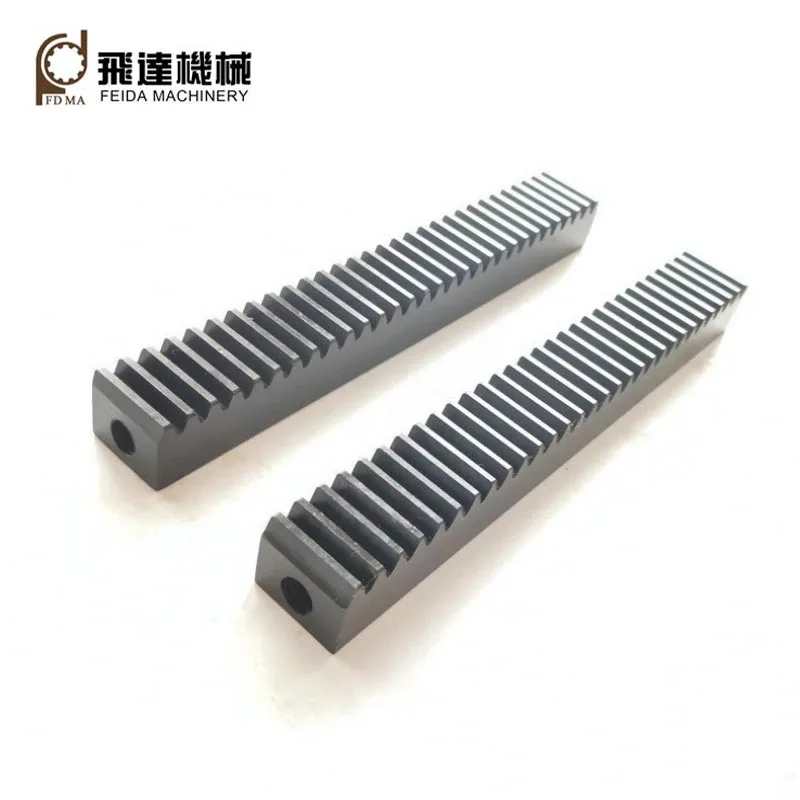
Metal Gear Racks
With more than 30 years experience,Feida Machinery factory produces high quality metal gear racks in its own factory.These products’ precision grade is up to ISO/DIN 8-10 level.We look forward to cooperating with you, if you want to know more, you can consult us now, we will reply to you in time!
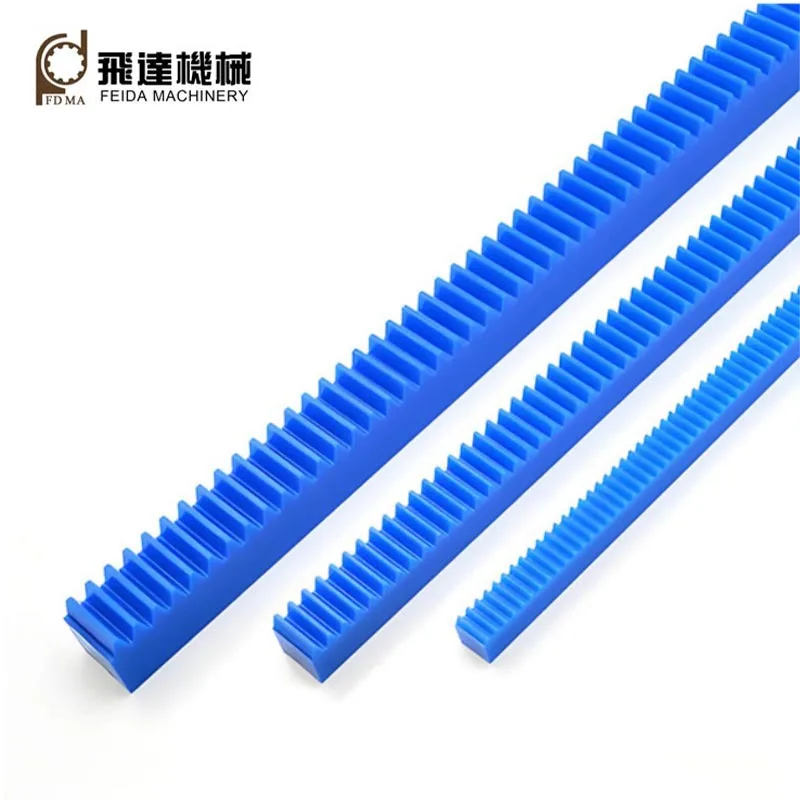
Plastic Gear Racks
With many years' production experience of plastic gear racks, Feida Machiney factory will be trusted by our advantages in competitive price, on-time delivery, good quality, on-hand engineering support and good after-sales services.OEM & ODM are acceptable.Welcome to contact us!
As a reliable Gear Racks manufacturer and supplier in China, we have custom options and volume discount pricing. Please just send us a quotation!