English
- English
- беларускі
- Hrvatski
- Тоҷикӣ
- O'zbek
- Español
- Português
- русский
- Français
- 日本語
- Deutsch
- tiếng Việt
- Italiano
- Nederlands
- ภาษาไทย
- Polski
- 한국어
- Svenska
- magyar
- Malay
- বাংলা ভাষার
- Dansk
- Suomi
- हिन्दी
- Pilipino
- Türkçe
- Gaeilge
- العربية
- Indonesia
- Norsk
- تمل
- český
- ελληνικά
- український
- Javanese
- فارسی
- தமிழ்
- नेपाली
- български
- ລາວ
- Latine
- Қазақша
- Euskal
- Azərbaycan
- Slovenský jazyk
- Lietuvos
- Eesti Keel
- Română
- Slovenski
- Srpski језик

Products
High precision customized helical gears for various industrial machinery requirements
Jinjiang Feida Machinery specializes in OEM and ODM helical gears, which feature smooth engagement, lower noise, and high load-carrying capacity.
With ISO9001:2015 certification, advanced technology, and equipment covering hobbing, gear shaping, gear grinding, heat treatment and CNC machining, we can support projects from sample development to batch production.
Basic Structure
Because the teeth gradually enter and leave engagement along the face width, helical gears generally provide smoother meshing than spur gears. Their main components are similar to those of other cylindrical gears and usually include addendum, dedendum, tooth flank, pitch circle, face width, and helix angle.
Material Selection for Different Operating Conditions
| Operating Condition | Common Material Choices | Reason for Selection |
| Low speed, light load, cost-sensitive | 45 steel, cast iron | Relatively low cost and adequate strength for general applications |
| General industrial gear reducers | 40Cr, 35CrMo | Good overall strength and toughness |
| Medium- to high-load, high-speed transmission | 20CrMnTi, 20CrMo | Suitable for carburizing and quenching; wear-resistant surfaces and tough cores |
| Heavy-duty, high-reliability gearboxes | 20CrNiMo, 18CrNiMo7-6 | Good strength, toughness, and fatigue resistance |
| Low-noise, light-load transmission | PA, POM | Lightweight, quiet, and offers good frictional properties |
| Special wear-resistant or corrosion-resistant applications | Bronze, PEEK, and others | Selected according to friction, temperature, and chemical-environment requirements |
Manufacturing Process
Raw Material Selection → Forging → Turning → Gear Hobbing → Heat Treatment → Gear Grinding → Inspection → Packaging
Quality Control & Certification
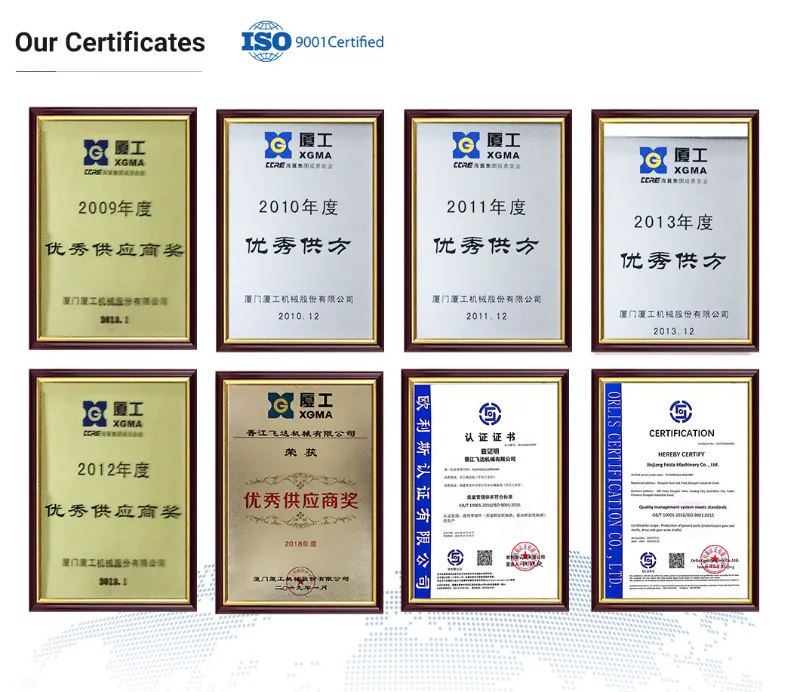
The Feida production process strictly follows its own quality system in accordance with ISO 9001:2015. Rigorous quality inspection is carried out at every step, right from raw material selection to final packing, including incoming material inspection, in-process monitoring, finished product testing, and pre-shipment inspection.
So far, Feida has cooperated with many well-known domestic and overseas companies such as Hitachi Energy, Zoomlion, XCMG, FAW, CATL and XGMA. It received the Supplier Excellence Award from XGMA from 2009 to 2013 and again in 2018.
Application Areas
Automotive transmissions
Used to transmit power from the engine or motor while reducing noise and improving driving performance.
Industrial gear reducers
Reduce rotational speed and increase output torque for conveyors, production machinery, and other equipment.
Machine tools
Used in spindles, feed systems, and other mechanisms requiring stable transmission.
Lifting and conveying equipment
Provide reliable power transmission under substantial loads.
Robotics and automation equipment
Used in precision drives, robotic joints, and motion-control systems.
Wind power and energy equipment
Used in certain gearboxes to transmit high power.
Shipping
Feida has a mature logistics system and import/export services. We support express delivery via UPS, DHL, FedEx and others, as well as air and sea freight, offering worldwide delivery.
Frequently Asked Questions
What is the difference between helical gears and spur gears?
| Comparison Item | Helical Gear | Spur Gear |
| Tooth direction | At an angle to the gear axis | Parallel to the gear axis |
| Meshing process | Gradual engagement | Relatively sudden engagement |
| Transmission smoothness | Generally better | Moderate |
| Noise level | Generally lower | Generally higher |
| Load-carrying capacity | Generally higher | Moderate |
| Axial force | Present | Ideally absent |
| Manufacturing difficulty | Higher | Lower |
| Manufacturing cost | Relatively higher | Relatively lower |
| Typical applications | Automotive transmissions, gear reducers, industrial equipment | Simple machinery, low-speed drives, instruments |
What are your customization options?
Customization is available for gear parameters (module, number of teeth, helix angle, pressure angle, tooth width), mounting structure, materials, heat treatment, precision, and surface treatment.
What are the helix directions of helical gears?
Helical gears are usually divided into left-handed and right-handed types. The helix direction must be selected according to the gear arrangement, shaft layout, and meshing requirements. For parallel-shaft helical gear transmission, a pair typically consists of gears with opposite helix directions.
- View as

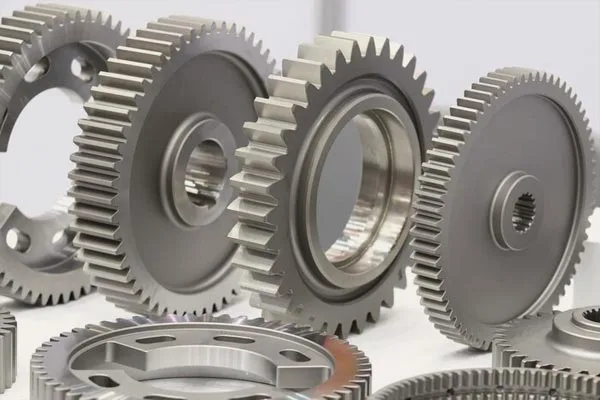
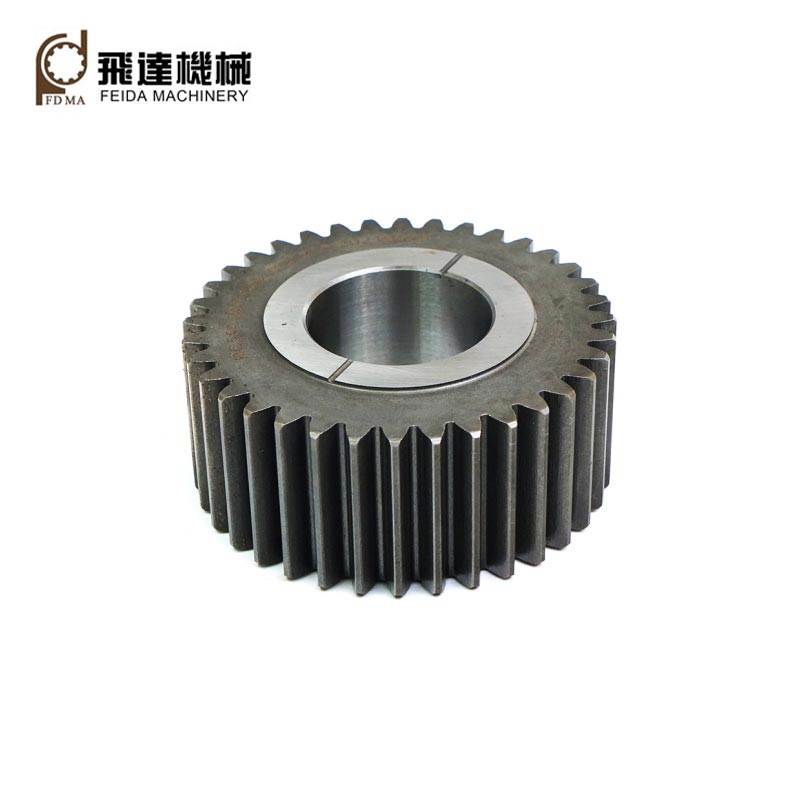
Metal Helical Gears
The distinct advantages of metal helical gears from Feida Machinery factory are high load capacity,smooth operation,and low noise.For customization,pls send drawings or samples to us!

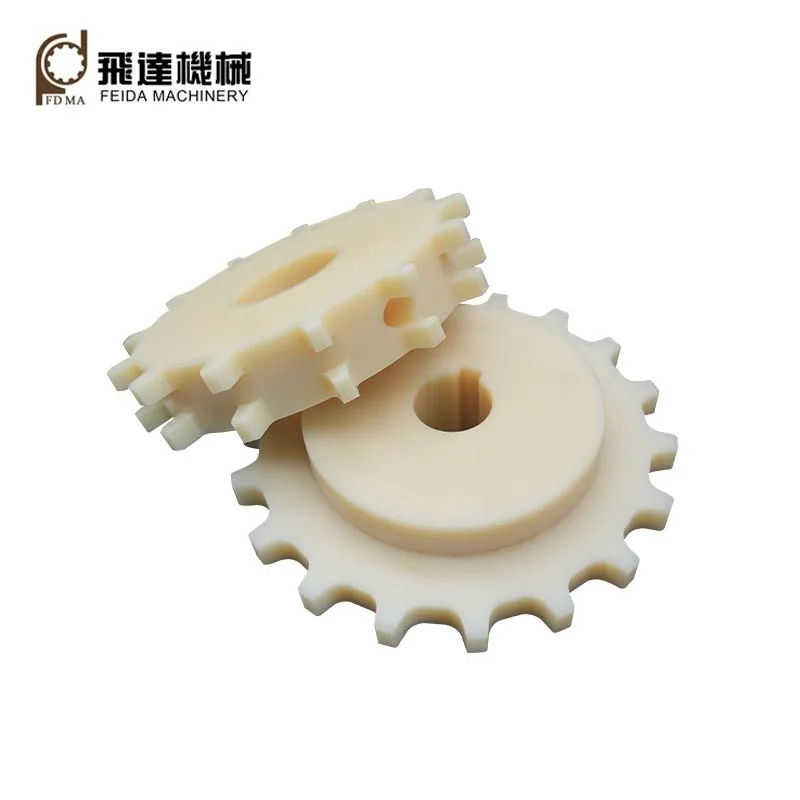
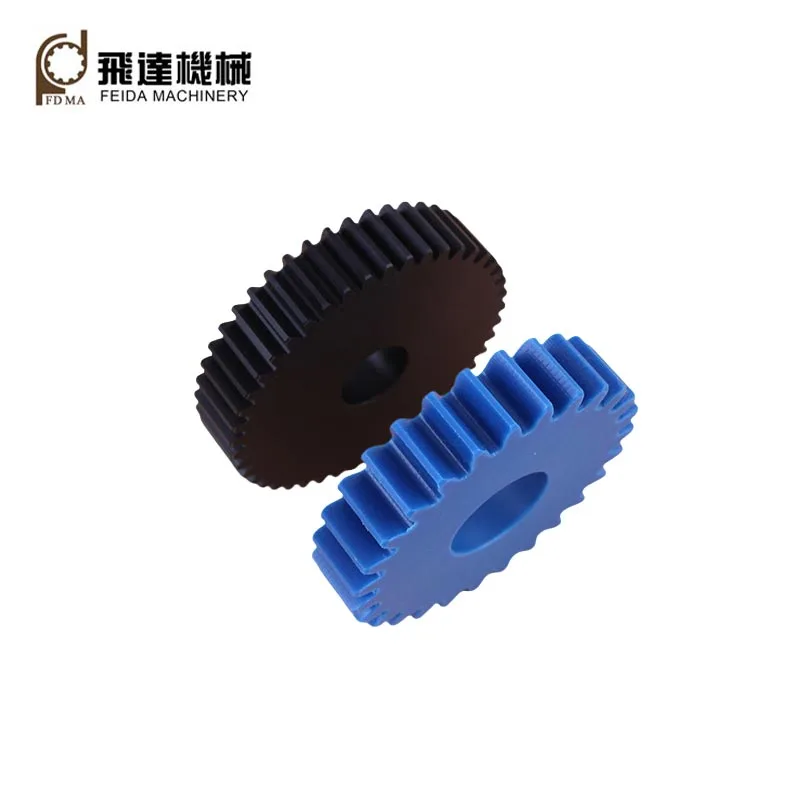
Plastic Helical Gears
High quality raw materials,professional production,and strict quality control allow Feida Machinery factory to supply high-class plastic helical gears to our clients at home and abroad.Whether you have detailed drawings or actual samples, we can work with you to bring your vision to life!
As a reliable Helical Gears manufacturer and supplier in China, we have custom options and volume discount pricing. Please just send us a quotation!