English
- English
- беларускі
- Hrvatski
- Тоҷикӣ
- O'zbek
- Español
- Português
- русский
- Français
- 日本語
- Deutsch
- tiếng Việt
- Italiano
- Nederlands
- ภาษาไทย
- Polski
- 한국어
- Svenska
- magyar
- Malay
- বাংলা ভাষার
- Dansk
- Suomi
- हिन्दी
- Pilipino
- Türkçe
- Gaeilge
- العربية
- Indonesia
- Norsk
- تمل
- český
- ελληνικά
- український
- Javanese
- فارسی
- தமிழ்
- नेपाली
- български
- ລາວ
- Latine
- Қазақша
- Euskal
- Azərbaycan
- Slovenský jazyk
- Lietuvos
- Eesti Keel
- Română
- Slovenski
- Srpski језик

News
How Do Internal Gears Improve Precision and Power Transmission?
Internal gears are precision transmission components in which the teeth are formed on the inside surface of a ring-shaped gear. When paired with an external gear, planetary gear, or pinion, they can deliver compact power transmission, high torque capacity, smooth engagement, and efficient use of installation space. However, choosing the wrong tooth profile, material, manufacturing tolerance, lubrication method, or mating gear can lead to noise, accelerated wear, backlash, and premature failure.
This guide explains how internal gears work, why they are important, where they are used, how to specify them correctly, and what buyers should check before placing an order.
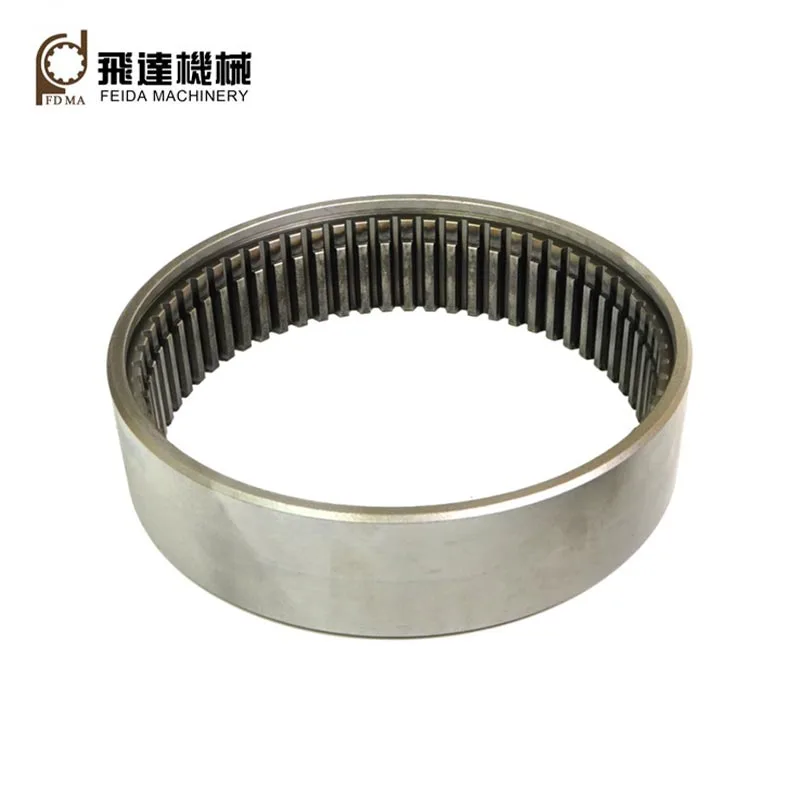
Table of Contents
- Understanding Internal Gears
- How the Structure Works
- Key Performance Advantages
- Common Industrial Applications
- Internal and External Gears Compared
- How to Select the Right Internal Gear
- Manufacturing and Quality Considerations
- Installation and Maintenance
- Purchasing Checklist
- Frequently Asked Questions
- Final Takeaway
1. Understanding Internal Gears
An internal gear is a toothed ring in which the gear teeth are positioned on the inner circumference rather than the outside diameter. It normally works with an external gear or pinion whose teeth engage with the internal tooth profile.
This arrangement creates a fundamentally different transmission geometry from a conventional external gear pair. Instead of placing two gears side by side, the smaller gear can operate inside the larger ring. The result is a compact mechanism capable of transmitting rotational motion and torque within a relatively small envelope.
Internal gears are particularly valuable when designers need high reduction ratios, concentric input and output arrangements, stable operation, or efficient use of available space. They are therefore widely associated with planetary gear systems, precision machinery, automation equipment, industrial drives, and specialized mechanical assemblies.
Key point: The value of an internal gear is not simply its ring-shaped design. Its real performance depends on accurate tooth geometry, correct mating components, suitable materials, controlled tolerances, and proper lubrication.
◆ ◆ ◆
2. How the Structure Works
The operating principle is straightforward: rotational force is transferred through the contact between the teeth of the internal gear and its mating external gear. As one component rotates, the tooth surfaces push against each other and create controlled movement.
In a planetary transmission, the internal gear is commonly called the ring gear. It interacts with planet gears and a sun gear to create different speed and torque relationships depending on which member is fixed, which member receives input, and which member provides output.
| Component | Primary Function | Typical Design Concern |
|---|---|---|
| Internal Gear | Provides internal tooth engagement and torque transmission | Tooth accuracy, hardness, concentricity |
| Planet Gear | Transfers motion between sun and ring gear | Load distribution and tooth contact |
| Sun Gear | Provides or receives rotational input | Pitch accuracy and surface strength |
3. Key Performance Advantages
For engineers and equipment manufacturers, internal gears can solve several mechanical design challenges simultaneously.
Compact Construction
Because the mating gear operates inside the ring, the transmission can achieve substantial functionality without requiring a large external footprint.
High Torque Capability
Planetary arrangements can distribute loads across multiple gear contacts, making the architecture suitable for demanding torque transmission.
Smooth Operation
Accurate tooth geometry and proper engagement can reduce vibration, impact loading, and unnecessary noise during continuous operation.
Flexible Transmission Design
Internal gears support multiple planetary transmission configurations, allowing designers to balance speed, torque, direction, and packaging requirements.
These benefits become especially important when a machine must deliver reliable motion from a limited installation space. In precision applications, even small improvements in gear accuracy can influence positioning consistency, operating noise, component life, and overall system efficiency.
4. Common Industrial Applications
Internal gears are found in many systems where compact and controlled transmission is required. Their applications extend from heavy machinery to precision automation.
- Planetary gearboxes: Internal ring gears are fundamental components in many planetary transmission systems.
- Industrial machinery: Compact gear arrangements can help drive equipment where installation space is limited.
- Robotics and automation: Accurate internal gearing can support controlled movement and repeatable positioning.
- Material handling equipment: Gear systems can provide controlled torque for conveyors, lifting mechanisms, and drive assemblies.
- Automotive and mobility systems: Planetary transmissions use internal ring gears to achieve different speed and torque relationships.
- Machine tools: Precision gear components can be used in compact motion-control mechanisms.
Application requirements vary considerably. A low-speed industrial gearbox may prioritize load capacity and durability, while a robotic actuator may place greater emphasis on backlash, noise, dimensional accuracy, and repeatability.
5. Internal and External Gears Compared
Internal and external gears are not simply interchangeable versions of the same component. Their geometry, engagement conditions, applications, and manufacturing considerations differ.
| Feature | Internal Gear | External Gear |
|---|---|---|
| Tooth Location | Inside the ring | Outside the gear body |
| Typical Arrangement | Often used concentrically | Often arranged side by side |
| Space Efficiency | Excellent for compact planetary systems | Depends on gear arrangement |
| Common Use | Planetary transmissions and compact drives | General-purpose gear trains |
6. How to Select the Right Internal Gear
Selecting an internal gear should begin with the operating conditions rather than simply the outside diameter or tooth count. A technically suitable gear must match the complete transmission system.
- Define the torque requirement. Determine continuous torque, peak torque, starting loads, and expected shock loads.
- Confirm the gear ratio. Tooth numbers must be compatible with the intended planetary or gear arrangement.
- Check rotational speed. Higher speeds increase the importance of balance, tooth accuracy, lubrication, and surface finish.
- Choose suitable material. Common options include various grades of alloy steel and other engineering materials depending on load and operating environment.
- Specify hardness and treatment. Heat treatment or surface hardening may improve wear resistance and load-bearing performance.
- Control dimensional tolerances. Bore size, pitch geometry, concentricity, runout, and tooth profile should be considered together.
- Consider the working environment. Temperature, contamination, moisture, lubrication, and duty cycle can all affect service life.
Buyer tip: If the internal gear is being used as part of an existing gearbox, provide the manufacturer with the mating gear information whenever possible. Matching components as a complete system is usually more reliable than specifying the ring gear independently.
◆ ◆ ◆
7. Manufacturing and Quality Considerations
Internal gear manufacturing can require specialized equipment and careful process control because the teeth are located inside the component. The manufacturing route depends on gear size, tooth geometry, material, required accuracy, production quantity, and application.
Important quality factors include:
- Accurate tooth profile
- Correct pitch dimensions
- Consistent tooth spacing
- Controlled concentricity
- Low unwanted runout
- Appropriate surface hardness
- Suitable surface finish
- Traceable quality inspection
A reliable supplier should be able to discuss the gear's material, manufacturing process, dimensional requirements, heat treatment, inspection standards, and expected application. For custom components, drawings and technical specifications should be reviewed carefully before production begins.
Jinjiang Feida Machinery Co., Ltd. can work with customers who require industrial gear components and customized mechanical solutions, helping buyers clarify technical requirements before production.
8. Installation and Maintenance
Even a high-quality internal gear can experience premature wear if it is incorrectly installed or operated. Proper alignment and lubrication are particularly important because gear teeth must maintain the intended contact pattern during operation.
- Clean the mating components before assembly.
- Verify shaft, bearing, and housing alignment.
- Check tooth engagement before applying full operating load.
- Use the lubricant recommended for the gearbox or transmission.
- Monitor unusual noise, vibration, heat, or backlash.
- Inspect the tooth surfaces periodically for pitting, scoring, cracking, or abnormal wear.
Maintenance frequency should reflect operating speed, load, duty cycle, contamination level, and manufacturer recommendations. Early detection of abnormal tooth wear can prevent damage from spreading to the mating gears and bearings.
9. Purchasing Checklist for Industrial Buyers
When sourcing internal gears, buyers often focus on price first. However, the lowest initial price may not produce the lowest total cost if poor dimensional accuracy or unsuitable materials result in downtime and replacement expenses.
| Requirement | What to Confirm |
|---|---|
| Dimensions | Outside diameter, bore, width, tooth dimensions, mounting details |
| Gear Geometry | Tooth count, module or pitch, pressure angle, profile requirements |
| Material | Material grade and mechanical requirements |
| Treatment | Heat treatment, hardness, surface treatment where required |
| Inspection | Dimensional inspection and applicable gear accuracy requirements |
| Application | Speed, torque, duty cycle, temperature, lubrication, operating environment |
For customized internal gears, a detailed technical drawing is one of the most useful documents a buyer can provide. If a drawing is unavailable, supplying dimensions, photographs, samples, mating gear information, and application data can help a manufacturer evaluate the requirement.
10. Frequently Asked Questions
What is an internal gear?
An internal gear is a ring-shaped gear with teeth formed on its inner circumference. It engages with an external gear or other compatible gear components to transmit rotational motion and torque.
Why are internal gears used in planetary gearboxes?
Their internal tooth arrangement allows the ring gear to surround the planetary gears, creating a compact and concentric transmission architecture with useful torque and speed characteristics.
What materials are commonly used for internal gears?
Material selection depends on load, speed, wear requirements, environmental conditions, and manufacturing specifications. Various steels and engineering materials can be used when their mechanical properties match the application.
Can internal gears be customized?
Yes. Customization can involve tooth count, dimensions, material, hardness, surface treatment, mounting features, accuracy requirements, and other design parameters. A technical drawing or sample is helpful when requesting a customized component.
What causes premature internal gear failure?
Common causes include excessive load, incorrect alignment, insufficient lubrication, contamination, unsuitable material or hardness, inaccurate tooth geometry, excessive backlash, and improper installation.
11. Final Takeaway
Internal gears provide an efficient solution for compact, high-performance transmission systems. Their internal tooth arrangement makes them particularly valuable in planetary gearboxes and other applications where space, torque, precision, and controlled motion are important.
For buyers and engineers, successful sourcing involves more than selecting a gear based on diameter and tooth count. Material, tooth geometry, hardness, dimensional tolerance, operating speed, torque, lubrication, mating components, and quality inspection all influence the final performance of the transmission.
Working with an experienced manufacturer can make the specification process easier, especially when the project requires customized dimensions or application-specific performance. A clear technical drawing, complete operating data, and accurate communication of the intended application can significantly reduce the risk of selecting an unsuitable component.
Need a Reliable Internal Gear Solution?
If you are sourcing internal gears for industrial machinery, planetary transmissions, automation equipment, or customized mechanical assemblies, Jinjiang Feida Machinery Co., Ltd. can help evaluate your requirements and develop a suitable solution.
Contact us with your drawings, specifications, application requirements, or existing gear samples to discuss your project.
Related News
- How Do Spiral Bevel Gears Improve Power Transmission in Demanding Machinery?
- What Makes Sprocket Gears Essential for Reliable Power Transmission?
- What costly downstream failures stem from overlooked spline‑shaft manufacturing process gaps?
- Why Are Plastic Helical Gears Becoming a Reliable Choice for Modern Mechanical Systems?
- Can in‑house spline production solve machinery OEMs’ costly field‑failure headaches?
- Will full-process integrated gear machining cut overseas reducer manufacturers’ three major hidden procurement losses?
Leave me a message