English
- English
- беларускі
- Hrvatski
- Тоҷикӣ
- O'zbek
- Español
- Português
- русский
- Français
- 日本語
- Deutsch
- tiếng Việt
- Italiano
- Nederlands
- ภาษาไทย
- Polski
- 한국어
- Svenska
- magyar
- Malay
- বাংলা ভাষার
- Dansk
- Suomi
- हिन्दी
- Pilipino
- Türkçe
- Gaeilge
- العربية
- Indonesia
- Norsk
- تمل
- český
- ελληνικά
- український
- Javanese
- فارسی
- தமிழ்
- नेपाली
- български
- ລາວ
- Latine
- Қазақша
- Euskal
- Azərbaycan
- Slovenský jazyk
- Lietuvos
- Eesti Keel
- Română
- Slovenski
- Srpski језик

News
Will full-process integrated gear machining cut overseas reducer manufacturers’ three major hidden procurement losses?
Global planetary reducer OEMs and robotics/aerospace component purchasers continuously face three irreversible hidden costs when sourcing metal internal gears: scattered separate processing factories break production traceability chains, making it impossible to submit complete material and precision test files for third-party factory audits; simple single-layer plastic packaging fails humid long-distance sea transportation, triggering tooth surface rust and dimensional deviation after container arrival; small machining workshops lack full heat treatment and grinding equipment, resulting in unstable tooth precision that raises reducer vibration and field failure rates after assembly. Feida’s full-chain integrated metal internal gear production covers forging, fine machining, heat treatment, precision grinding and multi-layer anti-rust packaging, unifying all production links in one factory, solving audit document shortages, ocean transit rust risks and unstable gear precision troubles for transmission equipment manufacturers worldwide.
1. Closed-loop full production chain realizes complete batch traceability for global factory audits
Most small gear processing vendors only undertake single working procedures such as turning or gear hobbing, forging and heat treatment are outsourced to different third-party workshops. Raw material heat numbers, heat treatment hardness records and grinding inspection data cannot be integrated into a unified batch file. European and North American transmission equipment brand auditors will suspend supplier qualification review if full-process traceability archives are missing. This factory completes all 9 core working procedures in independent workshops, recording testing data of each link for every batch of internal gears. Complete unified inspection reports including alloy composition, tooth profile precision and hardness can be exported at any time, helping buyers smoothly pass international supplier audit without supplementary third-party testing expenditure.
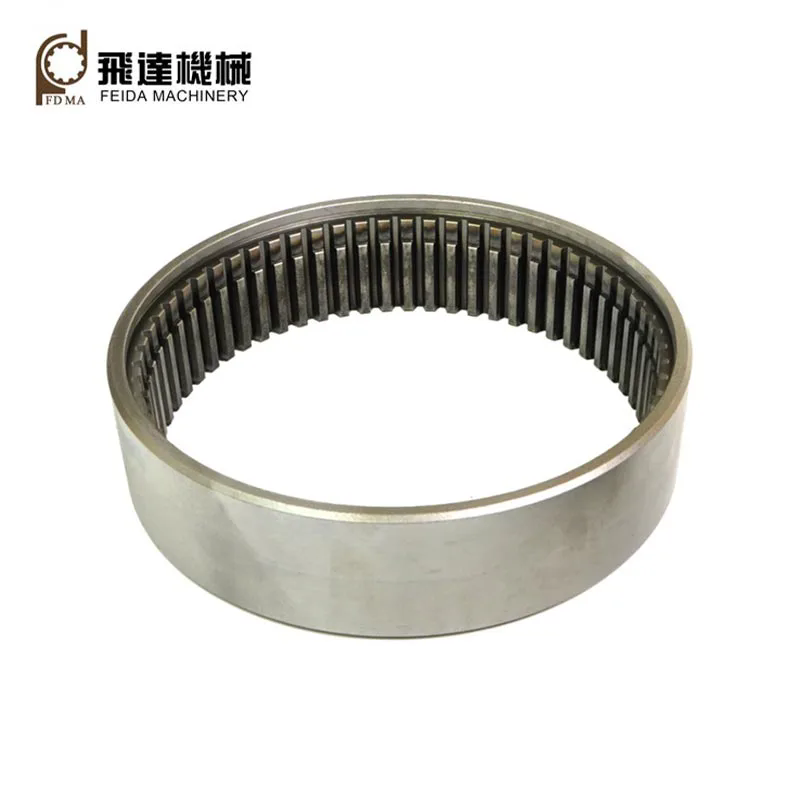
2. Multi-stage precision grinding stabilizes ISO/DIN 8-10 grade tooth accuracy under mass production
Machining factories without dedicated gear grinding equipment only rely on rough hobbing forming; tooth surface roughness and pitch deviation exceed standard limits after long-term heavy-load operation, leading to excessive reducer noise, vibration and premature tooth wear after assembly. Feida equips special gear grinders for post-heat treatment finishing, controlling involute profile error and cumulative pitch error within ISO standard tolerance range. Mass continuous production aging verification shows the internal gear maintains stable meshing accuracy after thousands of hours of cyclic load operation, drastically reducing after-sales maintenance caused by reducer abnormal vibration for robotics and heavy machinery manufacturers.
3. Targeted alloy material matching balances toughness and tooth surface wear resistance
Many gear suppliers use single universal steel materials for all working conditions, failing to distinguish low-load automation equipment and high-load heavy machinery application demands. Thin tooth surfaces of ordinary carbon steel wear rapidly under frequent impact loads, while full hard alloy blanks lack overall toughness and crack easily under alternating stress. The factory allocates matched metal blanks separately according to client equipment operating parameters: 40Cr/42CrMo alloy steel for heavy-load planetary boxes, 16MnCr5 carburized steel for aerospace reducers, 6061 aluminum alloy for lightweight robotic drives. The layered material formula ensures gear body impact resistance and tooth surface high hardness simultaneously, extending the whole reducer service cycle significantly.
4. Multi-layer VCI anti-rust packaging eliminates sea transit tooth corrosion defects
Ordinary single carton packaging lacks moisture isolation measures; container condensation during cross-border sea freight generates tiny rust spots on precise tooth surfaces, directly causing meshing failure after unpacking. The factory formulates classified packaging schemes based on gear size and transportation cycle: small precision gears adopt plastic inner boxes + VCI anti-rust mesh bags; medium and large workpieces use rust-proof paper wrapping + bubble buffer; bulk mass orders are loaded into sealed wooden cases with desiccant. Multi-layer moisture barrier structure adapts long ocean shipping to tropical and coastal humid regions, ensuring gear tooth surfaces remain intact without corrosion upon warehouse arrival.
5. Full module spectrum shortens prototype sample iteration cycle for R&D teams
Most gear manufacturers only stock partial module specifications; custom M0.5 ultra-fine or M8 large-module internal gears require long mold and tooling preparation cycles, delaying new reducer prototype testing progress. The factory reserves complete processing tooling covering M0.5–M8 full module range, supporting spur and helical internal gear custom development. Sample delivery cycle is controlled within 20 working days, helping robotics and aerospace R&D teams speed up new transmission product verification and market launch rhythm.
6. Independent QC laboratory realizes 100% full inspection before shipment
Processing plants without dedicated testing equipment only conduct random sampling inspection, and unqualified gears with out-of-tolerance tooth profiles easily flow into finished orders, causing mass assembly rework losses for downstream reducer factories. The independent inspection lab is equipped with CMM coordinate measuring instruments, gear comprehensive detectors and hardness testers, carrying out full dimensional, precision and hardness testing on every finished internal gear. Unqualified products are screened out before packaging, eliminating batch quality deviation risks brought by random sampling inspection for bulk export orders.
Related News
- How Do Spiral Bevel Gears Improve Power Transmission in Demanding Machinery?
- What Makes Sprocket Gears Essential for Reliable Power Transmission?
- How Do Internal Gears Improve Precision and Power Transmission?
- What costly downstream failures stem from overlooked spline‑shaft manufacturing process gaps?
- Why Are Plastic Helical Gears Becoming a Reliable Choice for Modern Mechanical Systems?
- Can in‑house spline production solve machinery OEMs’ costly field‑failure headaches?
Leave me a message